

Blog

All Irwin Toyota News Laconia Toyota Dealer Product Release Laconia Used Cars Helpful Tips Giving Back Laconia Toyota Service
in Irwin Toyota News

New Vehicle Owner Event 9/14

Have you purchased a new or used car recently? Irwin Toyota is hosting a New Owner Event this Thursday evening (9/14) from 5-6pm and YOU’RE INVITED!  Purchased elsewhere?  YOU’RE INVITED!  Join us for an evening of food, prizes, and education on maintaining your vehicle, how to keep its value, and optimize your gas mileage! We’d love to have you here with us!  Plan to be in attendance?  You can RSVP to Ed Kelley at Edward.Kelley@irwinzone.com or by calling 603.581.2953.  We look forward to seeing you there!
Read More

How Much Should I Put Down on a Car Loan?

If you are planning to finance the purchase of a new or used car, you are going to need to decide how much money to put down. Putting money down on a loan has several advantages, the most obvious of which is that the more you put down upfront, the less money you have to borrow, which lowers your monthly payment. There is another important way that putting money down can lower your payment: it can actually get you better interest rates from the bank. Lenders base the interest rate of the loan on the perceived risk of the loan. Someone who put $2,000 down on a loan is seen as being less likely to default on the loan than someone who puts no money down, and therefore may receive a lower rate on the loan than someone who puts no money down. A lower rate coupled with a smaller loan can knock some serious money off you monthly car payment! Putting money down on your loan has the added advantage of helping to protect you from being “underwater.” A vehicle is considered “underwater” when the amount owed is greater than the value of the car. Vehicles depreciate in value over time, but they depreciate at a faster rate during the first year. New vehicles, in particular, depreciate as soon as they drive off the lot for the first time and are no longer “new.” Putting money down, helps to offset this depreciation, as it keeps the size of the loan smaller relative to the value of the vehicle. How much should you put down? It is entirely up to you. You do not have to put any money down; it is just advantageous to do so. Traditionally, a 20% down payment was considered standard, although Edmunds.com reports that the average down payment these days is closer to 10%. Again, the more you put down, the smaller the loan, the lower the payment, and the better the rate. If you cannot afford to put money down but you are concerned about owing more than your car is worth in the event that your vehicle is totaled, we offer a product called “GAP insurance” that will cover the difference. One of our financial services managers would be delighted to tell you more about this product if you have any questions.

How to Rebuild Your Credit Score

It is important to maintain a good credit score. A high credit score gets you access to the lowest financing rates, meaning that you will pay less in interest when you borrow money to finance the purchase of something like a car or home. Additionally, many employers (and even some landlords) pull credit checks on applicants to determine if a prospective employee or renter pays his or her bills on time. But sometimes, life events happen that can lower your credit score. Maybe you lost your job for a time, maybe the mortgage crisis struck too close (literally) to home, or maybe you just fell behind on a few payments due to an emergency or medical crisis. If these things happened to you then your credit score almost certainly a hit. If you are looking to rebuild your credit, a car loan is an excellent way to do so. The standard unit of determining credit worthiness is called a FICO score, which is named after Fair Isaacs and Company, the firm that pioneered this scoring process. Your credit score changes over time, and moves up and down based on factors such as opening up new lines of credit, paying off older accounts, and so forth. According to Fair Isaacs and Company's website, a FICO score is based on 5 factors with different weighting: payment history (35%), amounts owed (30%), length of credit history (15%), new credit (10%), and types of credit used (10%). By examining the criteria that make up a score and their relative weighting, we can infer that a good score will be earned primarily through a history of making payments on time, on accounts that have been open for a long period of time, and with outstanding balance on "good" credit (e.g. car loans and mortgages) rather than on "bad" credit (e.g. credit cards). This shows that taking out a loan to buy a car, and making payments on time will make a good score even better. Moreover, it shows that a car loan can also be a good step towards repairing a credit score that is not as high as you would like. Since payment history is the most heavily weighted category (35% of the total score) and a car loan is also one of the "good" types of credit used, taking out a car loan and making timely payments can begin to repair a credit score quickly.

IMG_0020

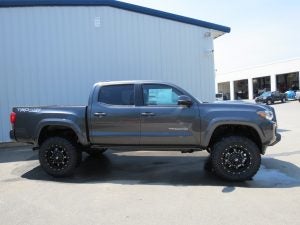
2016 Toyota Tacoma with a Lift Kit

We just got in a brand new 2016 Toyota Tacoma TRD Sport Double Cab 4x4 and promptly got it ready for some serious offroad action. We had our friends over at Truck Trends in Belmont, NH upfit this Tacoma with a 3" ReadyLift kit, as well as big, meaty 18-inch tires and blacked-out alloy rims! Check out our 2016 Toyota Tacoma with a 3" Lift Kit. Better yet, stop by and see it in person!

How Does A Lease Work?

Leasing a great option for many, many drivers, but not everyone takes advantage of this affordable driving solution. When you lease a car, you are paying to borrow a car for a set amount of time and a given number of miles. Instead of paying for the whole car, you are only paying for the portion that you use (depreciation) and the money rate factor (rent charge). At the end of the lease, you have several options: 1 ) you can drop the keys off and walk away 2) you can buy the car for yourself 3) you can sell the car 4) you can use the car like a trade-in towards another purchase or lease and 5) sometimes, you can extend you lease for another few months. Your monthly lease payment is the sum of the monthly depreciation payment and the rent charge. Depreciation is just the difference between the selling price of the vehicle and the residual value (which you know at the time of the lease), divided by the number of months. So, if the selling price of a hypothetical vehicle is $20,000 and the residual value is $16,400, then the monthly depreciation payment on a 36-month lease is $100. The monthly rent charge would be calculated by adding the residual to the selling price and multiplying that sum by the money rate factor. For example, using a money rate factor of 0.00140, the monthly rent charge would be ($20,000 + $16,400) * 0.00140, which is $50.96. In this example, the total monthly lease payment would be $150.96 every month for 36 months. For the sake of comparison, a 60-month loan at 3% APR on that very same hypothetical car is $359.37 per month People often say that they do not want to lease because they would prefer to own a car. The fact of the matter is that you do not own a car until you make the final payment. In the above example, it is the bank’s car for the first 60 months before you own the car, but you are still responsible for replacing the tires, brakes, etc. as needed. In short, you do not own the car, but you own all the headaches that come with it. In contrast, when you lease a car, you own five great options and never have to worry about being “underwater” when your loan is more than your car is worth. When you lease a new car, you have a new car warranty, and when you lease a Toyota Certified Pre-Owned vehicle, you get one of the strongest certified warranty programs around.

What’s the deal with hybrid vehicles?

A lot of customers ask us what hybrid vehicles are and how they work. These vehicles are, as their name implies, literally a hybrid between an electric vehicle and a gasoline-powered vehicle. A hybrid vehicle has both a gasoline-powered motor as well as an electric motor. The electric motor is powered by a dedicated battery (not the same one that powers the lights and radio) which is charged through a process called “regenerative braking.” Regenerative braking uses a vehicle’s brakes to charge the battery. The friction required to slow or stop a moving vehicle generates a tremendous amount of heated energy, which is converted into electric energy and stored in the dedicated battery. Once the battery has sufficient energy stored, the hybrid vehicle will shut off the gasoline motor and use the electric motor to power the vehicle. Once the store of electricity has been depleted, the vehicle automatically turns the gasoline engine back on. Many types of vehicles (including SUV’s) are available in hybrid models. In fact, the Toyota RAV4 (the best-selling passenger car in New England!) just launched a hybrid version a couple months back. The all-new 2016 Toyota RAV4 Hybrid has been very well received. Because hybrid vehicles recharge their batteries in stop-and-go traffic they have a particular quirk: unlike their gasoline-powered counterparts, they actually have better fuel economy in city driving than they do on the highway. To give a real life example, the Toyota Camry is available as both a gasoline-powered sedan as well as a hybrid vehicle. The gasoline version is rated at 25 mpg in the city, a very respectable 35 mpg on the highway, and a combined rating of 28 mpg. The hybrid version of this same vehicle is rated at 43 mpg in the city, 39 mpg on the highway, and 41 mpg overall. So , on average, the Camry Hybrid is 46% more efficient than the conventional Camry. but in city conditions, the Camry Hybrid is 76% more efficient than the gasoline version! It is for this exact reason that so many taxis in Boston are Camry Hybrids. While anyone can benefit from the improved fuel economy of hybrid vehicles, people who live and work in cities stand to benefit the most.

Is This is Lowest Possible Monthly Payment Option?

Many people who lease do it for two reasons 1) so that they can always drive new cars and 2) because it costs much less than buying. Let’s focus on the affordability of leasing for a moment. When you lease a car, you are paying to borrow a car for a set period of time. Since you are only paying to use the car and not to own it, you monthly payment will be lower than if you took a loan out to buy the car outright. Think of it as renting an apartment versus buying a home. Just as renting an apartment saves you the headaches and costly repairs that come with home ownership, leasing is an affordable, stress-free alternative to car ownership. You do not actually own the car, so you don’t have to worry about any of the major expenses that can come with car ownership. Additionally, your car is under a manufacturer’s warranty, so you have peace of mind. An even more affordable alternative to leasing a new car is leasing a pre-owned car. With this in mind, Irwin Toyota is proud to announce that we have begun leasing Toyota Certified Pre-Owned vehicles through Toyota Financial Services. The advantage of leasing a pre-owned vehicle is that costs even less on a monthly basis than leasing the equivalent new car. The reason for this is simply that a portion of your lease payment is based on the depreciation of the vehicle over the life of the lease. The single biggest depreciation hit in a vehicle’s life occurs when it is sold as a new car and drives off the lot for the very first time. Since a used car has already incurred this initial drop in value, additional depreciation will occur at a slower rate, resulting in a lower lease payment. To give a more concrete example, a 24-month, 15,000-mile/year lease on a Certified Pre-Owned 2014 Toyota Camry will cost substantially less than a 24-month, 15,000-mile/year lease on a new 2016 Toyota Camry, while still providing the peace of mind of the Toyota Certified Program and a nearly new vehicle.

Is Presidents Day a Good Time to Buy a Car?

Why is Presidents Day known as a great time to buy a car? The Presidents Day Sales Event has been an automotive industry staple for years, but there is no clear consensus on exactly how and why this started. Locally, the Presidents Day tradition dates back to 1917, when Alvan T. Fuller (later governor of Massachusetts) promoted a Presidents Day “open house” event at his Cadillac and Packard dealership on Commonwealth Avenue. The most notable advantage of having a sales event on Presidents Day is that many people have the day off from work and are able to visit the dealership and go for test drives. Despite early efforts by dealers like Fuller, Presidents Day car sales events did not take off on a national basis until the 1970’s. It is worth noting that prior to 1971 Presidents Day was always celebrated on George Washington’s actual birthday (February 22 nd), regardless of the day of the week. In 1971, the Presidents Day holiday was moved to the third Monday in February, ensuring that it would always create a three-day weekend. This newly formed three-day weekend happens to fall at a convenient time for both dealers and prospective customers. Dealers and manufactures alike are starting to enter “spring cleaning” mode to make room for new models, so they offer discounts and rebates to help move aging product. Customers have recovered from the holiday expenses incurred back in December, and many of them have received tax refund checks. Tax refund checks make excellent down payments, and can be combined with rebates from the manufacturer to help lock in low monthly payments. As you can see, there is no one reason why Presidents Day has become so big in the automotive industry; rather, it is a combination of factors that help to make it a great time to buy a car.

Do I Need AWD or 4WD for the Winter?

Now that we are finally getting some snow this winter, I'm sure a lot of you noticed how bad the roads were in New Hampshire today. There is nothing like a fresh pile of wet, heavy snow to make to think twice about the vehicle you are driving and how safe your tires are. So what exactly does drivetrain have to do with how a vehicle handles in the snow and ice? It helps to know a little bit about drivetrains; they transfer the power from the motor to the wheels to make a vehicle move. There are 3 different types of drivetrain to consider. The oldest is rear-wheel drive (RWD). RWD vehicles transfer the power from the motor to the rear wheels, which "push" the car forward. The front wheels do not deliver power, they are just used for balance and steering. The advantage of RWD cars is that they have excellent "balance" and control. They excel at hugging curves, and deliver a driving experience that tends to be more "fun" than some of their counterparts. It is for this reason that most sports cars are rear-wheel drive. About 30 or 40 years ago, there was a sudden interest in a bold new design: the front-wheel drive vehicle. As the name implies, front-wheel drive (FWD) vehicles transfer power to the front wheels which "pull" the car forward. There are a few advantages that the FWD vehicles have over RWD vehicles. The first advantage is that by eliminating the need for a driveshaft running from the engine block to the rear axle, the car becomes simultaneously lighter and more spacious. And a lighter car is a more fuel-efficient car, so the FWD vehicles are more practical from a fuel economy perspective. The improvement in fuel economy was a primary driver in widespread adoption of the FWD platform, especially after the OPEC embargo of 1973-74 and the Corporate Average Fuel Economy standards enacted by Congress in 1975. Finally, FWD vehicles handle much better in wet, slippery road conditions. The reason for the improved handling is that the engine block's weight on the front axle helps push down on the tires to achieve better traction on the road. The third and final category of drivetrains is the 4-wheel drive (4WD) and all-wheel drive segment (AWD). There is a slight distinction between 4WD, which is manually selected by the driver, and AWD, which is controlled by a computer that distributes power where it is needed. But in both cases, all four wheels help propel the vehicle forward. As you can imagine, the 4WD/AWD category combines the traits of both the RWD and FWD cars. It is even better in slippery road conditions than FWD cars, although fuel economy does suffer a bit. For the very best traction and vehicle control in inclement driving conditions, AWD/4WD is the way to go. That being said, you can improve the traction of your FWD or RWD vehicle considerably with the addition of snow tires.

Will There Be an All-Wheel Drive Prius?

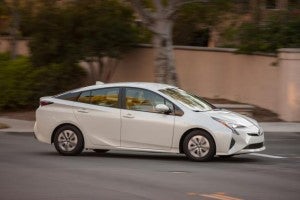
Next month, Toyota will be debuting something big: the 2016 Prius will be the first car in Toyota’s lineup to feature something called the Toyota New Global Architecture (TNGA) platform. TNGA will become the standard, global platform for all Toyota cars and SUV’s over the next several years. What this means is that, by 2020, the Camry, Corolla, Prius, Yaris, Avalon, RAV4, and Highlander will all run on the same platform, with interchangeable components such as the drivetrain. The implications for this change are huge; it would make it feasible to have an AWD Prius and Camry, for example. The other major benefit to this strategy is that is allows Toyota to increase its economies of scale across its global supply chain. Because Toyota will just be building TNGA platforms instead of Camry platforms, Prius platforms, RAV4 platforms, etc., Toyota will be able to buy the materials and component parts and assemble them into TNGA platforms in a more cost-effective manner. Toyota is ever mindful of the fuel efficiency requirements under the new Corporate Average Fuel Economy (CAFE) standards, and this new platform will play a role in helping Toyota achieve its goals The very first nameplate to feature TNGA will be the 2016 Prius, which arrives next month. The 2016 Prius Prius has a more modern look, complemented by striking body lines; the creases in the rear fenders and doors are particularly elegant. The Prius remains very aerodynamic, and is rated at 54 mpg on the base model, and 58 mpg on the Prius Two Eco trim level! With a starting MSRP of $25,260, the Prius will compete directly with mid-size sedans that only get around 35 mpg.

Are Your Tires Safe Enough?

Tires are one of the most important parts of your vehicle since they connect you to the road. Whether you have snow tires for the winter, or you are using all-season tires, it is important to know more about them, and to maintain them properly. Tires should always be properly inflated, have plenty of tread, and be free from signs of damage, weather cracking, or uneven wear. Snow tires are specifically designed to grip the road in cold, icy conditions. Snow tires achieve superior traction through a more aggressive tread pattern and a softer rubber compound. So why have snow tires? Why not just make all tires have better tread and grip? The answer is that the different rubber compounds work better at different temperatures. The softer rubber compound functions best in colder weather (generally below 45 degrees F), and will actually wear more quickly in warmer weather, whereas summer tires are designed to function best in warmer weather. For this reason, it is important to take your snow tires off once warm spring temperatures arrive to help prolong the life of your snow tires. By contrast, all-season tires are made from a harder rubber compound that can handle the warm summer roads, but do not provide as much traction in the ice and snow. Regardless of whether you use snow tires or all season tires, it is important to note that not rotating tires can cause them to wear out more than three times as quickly. Tires that are not rotated can wear unevenly, becoming "chopped." At first, chopped tires will be only a minor nuisance; they will be noisier and less fuel-efficient than tires with even wear. Over time, however, the chop will become so severe that the tires will no longer pass a state safety inspection, even as early as 20,000 miles! Keeping your tires properly inflated and having them rotated every 5,000 miles or so will help them last longer. In fact, keeping your tires properly inflated has the added benefit of improving your fuel economy. As far as rotating your tires, we offer free tire rotations for the life of every tire we sell.

2016 Prius NH sale

Is this the perfect car?

The game-changing, head-turning 2016 Toyota Prius will be available for sale next month, and we are getting pretty excited about it! This is far from a model year change; and it is not just a redesign, either. The all-new 2016 Prius has been completely re-imagined, and will be the very first Toyota product to feature the all Toyota New Global Architecture (TNGA) platform. TNGA is a global platform that will be used across the full lineup of Toyota cars and SUV’s in the coming years, beginning with the 2016 Prius. TNGA will increase economies of scale, and simplify ordering and production across Toyota’s line-up. The implementation of TNGA will be staggered over several years; although the Prius debuts in February, the RAV4, Camry, and Avalon will not switch to TNGA until 2018, and the Highlander will follow suit in 2020. The sleek, futuristic look of the new 2016 Toyota Prius will appeal to a wide audience Needless to say, the 2016 Prius will be huge launch for Toyota. The Prius continues to raise the bar for fuel economy by delivering an incredible 58 mpg in the optional Eco trim level, and 54 mpg on all other models. And while the all-new Prius still provides the exceptional fuel economy for which it is known, its exterior barely resembles the iconic body style of the outgoing hatchback. The 2016 Prius has a more modern look, complemented by striking body lines. The hatch has a more refined, tapered look to it, and the creases in the doors and rear fenders are especially eye-catching. Despite the stylish body changes, the 2016 Prius remains aerodynamic and achieves a 0.24 coefficient of drag, allowing it to cut through the wind and boost fuel economy. And with a starting MSRP of $25,260, the 2016 Prius is only $1,000 more than a Camry LE, with 54% better fuel economy! For an additional $500, you can get the Prius Two Eco trim level and snag an extra 4 mpg. The redesigned hatch offers a more elegant, tapered look than the outgoing 3rd Generation Prius The interior of the new Prius has even higher-quality materials than before, more comfortable seats, and better visibility. The trunk boasts an impressive 27.4 cubic feet of storage space. For any technophiles out there, don’t miss out on the optional Advanced Technology Package, which provides dynamic radar cruise control, lane departure alert, pre-collision system with pedestrian detection, and much more! The 2016 Prius boats a ton of the latest and greatest technology

Is the 2016 Toyota RAV4 Hybrid the Best SUV on the Market?

Toyota expects to sell 400,000 RAV4’s next year, of which 50,000 (12.5%) will be Hybrid models. The biggest draw of the 2016 Toyota RAV4 Hybrid model line is that it will be an AWD vehicle that gets 34 MPG. Plus, it will be backed by the incredible reputation for quality and reliability that has made the RAV4 so wildly popular. The RAV4 Hybrid is available in two trim levels: XLE AWD and Limited AWD. Both of these vehicles are powered by a 2.5-liter 4-cylinder hybrid engine with 194 net horsepower and 206 lb/-ft. of torque. The RAV4 Hybrid has best-in-class combined and best-in-class fuel economy. It also delivers more horsepower, faster acceleration, and better fuel economy than the conventional RAV4 lineup. The all-new RAV4 Hybrid will feature updated exterior styling, including a new front end from the hood line down, as well as standard roof rails, and front and rear skid plates. The Hybrid Limited trim level will come standard with chrome outside door handles. When you sit in the RAV4 Hybrid, you will notice the refined cabin, including more soft touch surfaces and improved materials throughout. Thicker padding on the lower dash provides a soft and luxurious tactile experience. Take this RAV4 for a spin and you will notice that the cabin is quieter than ever thanks to increased sound insulation. In addition to a thicker sound insulation layer, the silencer area has been expanded by 55%. An anti-vibration rubber cushion mounting has been adopted to reduce the drivetrain noise and vibration in the cabin. As far as technological goodies are concerned, the RAV4 Hybrid boasts such available amenities as a 7-inch touch screen (a 4.2-inch screen comes standard), Bird’s Eye View Camera with Perimeter Scan, and Connected Navigation through Scout GPS link. A Power Tilt and Slide Moonroof comes standard on both the XLE and Limited trim levels. Toyota Safety Sense is the latest safety technology developed by Toyota and comes standard on both the RAV4 Hybrid XLE and RAV4 Hybrid Limited. Toyota Safety Sense features a pre-collision system, dynamic radar cruise control, auto high beams, pedestrian detection, and lane departure alert with steering assist. For additional safety, all RAV4 Hybrid models will come standard with Hill-Start Assist Control and Trailer Sway Control. Front and Rear Park Sonar and Blind Spot Monitor with Rear Cross Traffic Alert both come stand on the Hybrid Limited and are each available options on the Hybrid XLE. The 2016 Toyota RAV4 Hybrid delivers improved ride and handling, thanks to several adjustments to the suspension and steering. The front suspension features a MacPherson strut with stabilizer bar and hydraulic shock absorbers. The rear suspension is a double-wishbone configuration with coil springs, trailing arms, stabilizer bar, and hydraulic shock absorbers. The steering feel is more direct, thanks to a tapered structure for both the suspension member and surfaces of the steering gear box, which produces more rigidity (and less play) for an enhanced driving feel.

Contact Us

Fill out this form below and we'll contact you shortly
*Required Fields